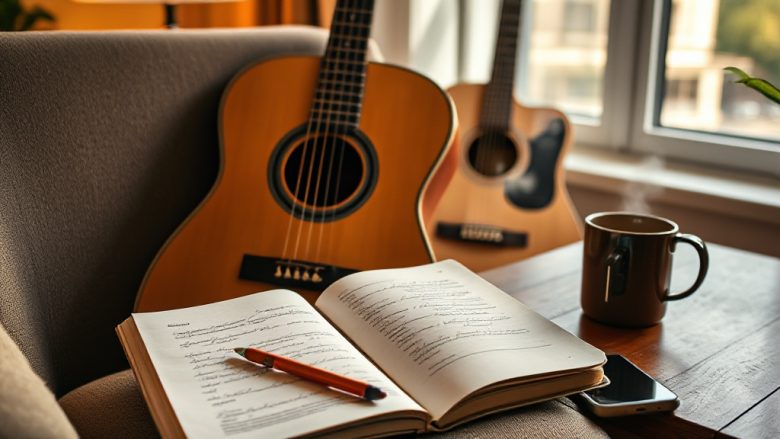
Most first songs are bad. Not mediocre. Bad. The rhymes are clumsy, the melody wanders, and the second verse says the same thing as the first with slightly different words. If that sounds discouraging, it should be the opposite. Knowing that your first song will probably be rough is the single best reason to write it anyway. The goal of this guide on how to write your first song is not to produce something impressive. It is to produce something finished, because a finished bad song teaches you more than ten perfect ideas you never wrote down.
I still have a notebook from my own first attempt. The chorus rhymed “heart” with “apart,” and the bridge rhymed “fire” with “desire.” I cringe at it now, but that song is the reason I can write anything at all. It proved I could start something and end it. That is the only skill you need today.
Pick One Emotion to Build Your First Song Around
Beginners usually try to write about everything at once: love, loss, growing up, the state of the world. The result is a song with no center. Instead, choose a single feeling and let it run the whole thing. One emotion, one song.
Be specific about it. “Sad” is too broad. “The specific loneliness of leaving a friend’s house at midnight when everyone else is still laughing inside” is a song. “Angry” is a mood. “Frustrated that I keep apologizing for things I am not sorry about” is a lyric waiting to happen. The narrower your emotional target, the easier every later decision becomes, because you can ask one simple question at each line: does this belong to that feeling or not?
Write your chosen emotion at the top of a page in plain words. Underneath it, list five concrete moments from your own life that carry that feeling. Not ideas. Moments. A kitchen table. A bus stop. A phone that did not ring. Concrete images give you something to sing about, and they keep the song from floating off into vague poetry.
Find a Title or Hook Before You Write Anything Else
A hook is the short phrase people remember. It is usually the title, and it usually lands in the chorus. Find it early and it becomes the spine of the whole song.
Hooks work best when they are short, speakable, and a little surprising. “I never learned to say goodbye” is stronger than “I am sad that you left.” The first one has music inside it. You can hear where the melody would rise. The second one is a statement, not a hook.
Try this: write ten candidate phrases without judging them. Say each one out loud. The right hook is the one that makes you want to repeat it, hum it, or argue with it. When you find it, circle it. Everything you write from here should either set up that phrase or pay it off.
If nothing lands, steal from your own speech. Songwriters constantly lift lines from things they actually said that week. A throwaway sentence like “I keep waiting for the version of you that showed up last year” can become the whole chorus. You are not looking for poetry. You are looking for a phrase that sounds like a person.
Choose a Simple Structure for Your First Song
Structure is the part beginners overthink. You do not need an unusual form. You need a container that holds your emotion and your hook, and there is a reason so many songs use the same few shapes.
Start with the most common one: verse, chorus, verse, chorus, bridge, chorus. That is six sections, and each has a job. The verses tell the story or paint the scene. The chorus states the feeling and repeats the hook. The bridge offers a turn, a new angle, a moment of doubt or realization before the final chorus lands harder.
If that feels like too much, use verse, chorus, verse, chorus. Two verses and two choruses is a complete song. Nobody will complain that it is short. A tight two-minute song beats a four-minute song with two minutes of filler.
Decide your structure before you write a single lyric. It sounds rigid, but it is freeing. You stop wondering what comes next and start filling in the blanks. For a first song, the blanks are your friend.
Write the First Verse Without Judging It
Now the actual writing. The first verse has one job: pull the listener into the world of the song. It usually answers a few quiet questions. Where are we? Who is speaking? What just happened?
Open with an image, not a summary. “I am standing in the doorway with my keys still in my hand” puts us in a room. “I feel confused about us” puts us nowhere. Start in the middle of a moment, and the emotion will arrive on its own.
Keep the lines singable. Short lines are easier to set to music than long ones, and they are easier to remember. Aim for somewhere between six and ten syllables per line when you are starting out. You do not have to count strictly, but if a line runs long, your melody will struggle to hold it.
Rhyme loosely. Perfect rhymes are not required. Near rhymes like “home” and “alone,” or “back” and “that,” sound more natural and are easier to find. If a perfect rhyme forces a line that sounds like a greeting card, drop the rhyme and keep the meaning.
Write the verse in one sitting if you can, then leave it alone. Do not edit yet. Editing while drafting is how songs die at eight lines.
Add a Chorus That Says the Thing Plainly
The chorus is where your song stops describing and starts declaring. If the verse is the scene, the chorus is the point. It should be simpler, louder, and more repetitive than the verse, because repetition is what makes a hook stick.
Put your hook at the start or the end of the chorus, and repeat it. Repeating the title line is not lazy. It is the entire mechanism of a memorable chorus. The listener should be able to sing it back after one pass.
Keep the chorus language plain. Verses can be clever. Choruses should be clear. If you find yourself writing a metaphor with three moving parts in the chorus, move it to a verse and write something direct in its place.
One practical trick: write the chorus melody as if you were shouting it across a parking lot to a friend. If it survives that, it will survive anything. If it gets tangled in your mouth, simplify it.
Finish the Draft and Share It Before You Polish
Here is where most first songs stop. You have a verse and a chorus, and the song feels incomplete, so you keep rewriting the opening line for two weeks. Do not do that. Finish the draft instead, even if parts of it are weak.
Write your second verse by moving the story forward. If verse one set the scene, verse two can show what changed or what you are afraid of. Then write a short bridge if your structure calls for one. A bridge is often just two lines that admit something the rest of the song avoided.
Once the draft exists, sing it all the way through, start to finish, without stopping to fix anything. Record it on your phone. The recording will be rough and you will hear every flaw. That is fine. You now have a song instead of a fragment, and songs can be improved. Fragments cannot.
Then share it with one person you trust. Not a crowd. One person. Ask them what they remembered from it. Whatever they remember is probably your hook or your best image, and that tells you what to protect when you revise. Polish comes later. Finishing comes first.
Questions Beginners Ask About Writing a First Song
Do I need an instrument to write a song?
No. Plenty of songs start as words and a melody hummed into a phone. An instrument helps you test chords later, but it is not required to begin. Your voice and a notebook are enough for a first draft.
How long should my first song be?
Two to three minutes is plenty. A short finished song teaches you more than a long unfinished one. You can always add a verse later once the core works.
What if my first song sounds like a song I already know?
It probably will, and that is normal. Beginners absorb the music they love, and early work echoes it. Keep writing. Your own voice shows up after a few finished songs, not before.
Should I write the lyrics or the melody first?
Either works. Try both on different days. Some writers find the melody first because it suggests the emotional shape, and others find the words first because the hook arrives in language. There is no wrong order, only the one that gets you to a finished draft.
Your first song is not an audition. It is a rehearsal for every song you will write after it. Write the bad one. Finish it. Then write the next one, and the one after that, and watch how much better you get simply because you kept going.